Airport noise pollution means housing development reduced
TONY CARNIE
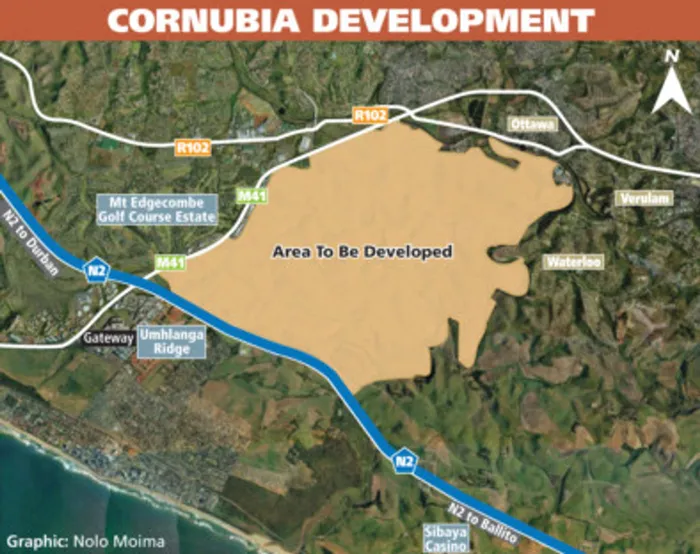
THE number of houses proposed for the first phase of the huge Cornubia development has been slashed by nearly 75 percent because of predicted future noise pollution levels from the King Shaka International Airport.
This is according to an amended version of the Cornubia environmental impact assessment (EIA) report published yesterday.
The amended report states that only 2 800 homes would be built in the first phase of the proposed development – compared with about 11 600 homes proposed in the original EIA report published last year.
However, the amended report gives no indication that the overall number of 50 000 houses would be reduced. The final number of residents has been calculated at about 200 000.
This suggests that the density of homes in later phases could be increased substantially to take up some of the land sterilised for residential development through noise pollution.
Some of the Cornubia land affected has been rezoned so that commerce and light industry would be in the noisiest section of the 1 300ha site.
According to the SSI consultancy group carrying out the EIA, the changes to the plans became necessary when eThekwini municipality stipulated in July that no homes should be built where the level of ambient noise reached 55 decibels.
None of the Cornubia land falls within this noise control limit, but modelling results show that land on the eastern side would be affected by the 55db limit in 2035 because of growing aircraft traffic and noise levels at King Shaka.
As a result, the plans have been revised to shift commercial and industrial land uses to where some houses would have been in the initial plan.
“As a result of the removal of residential (development) from the noise contour, the size of phase 1 of the Cornubia development has been reduced significantly from an initial 614ha to 295ha,” the report states.
Cornubia is a joint project by the municipality and Tongaat-Hulett Developments, and includes a significant proportion of free low-cost houses, known as “breaking new ground” (BNG) units.
The consultants report that, “on the whole, almost all communities likely to be affected are excited and enthusiastic” about the project, particularly those of areas such as Ottawa, Phoenix, Verulam and Waterloo.
However, they concede that “for a smaller number of people living in the more resourced areas such as Mt Edgecombe, the perception is that the increase in population, the densification of the urban landscape and the increase in traffic will impact negatively”.
The report notes that the transport infrastructure in the northern Durban region is “stretched” and would come under increasing pressure from the development of Cornubia, King Shaka and the Dube trade port.
“The negative impact of crime resulting from an increase in population by approximately 50 000 households (at least 15 000… from impoverished circumstances) is likely to be a reality,” the report says.
Unless several police stations were built in the area, it was likely that increased crime would create “major problems and concerns” for neighbouring communities.
The consultants add it is unlikely that residents of the BNG precinct would have the resources to maintain their homes and surroundings adequately.
“It is proposed that a fund be established at the earliest by the developers, into which all homeowners pay a small levy, expressly for the purpose of maintaining the precinct.
“An issue of significant concern is the perception that the process of allocation (of free houses) is not transparent... Residents from the lower income groups who did not qualify for BNG houses were concerned that processes for accessing houses at Cornubia were bound to be ‘corrupt’.”
To access the amended draft EIA report, visit www.bohlweki.co.za or call Real Consulting at 031 765 6670, or e-mail luci@realconsulting.co.za or dennis@strategicplan.co.za