

Melanie Gosling
Environment Writer
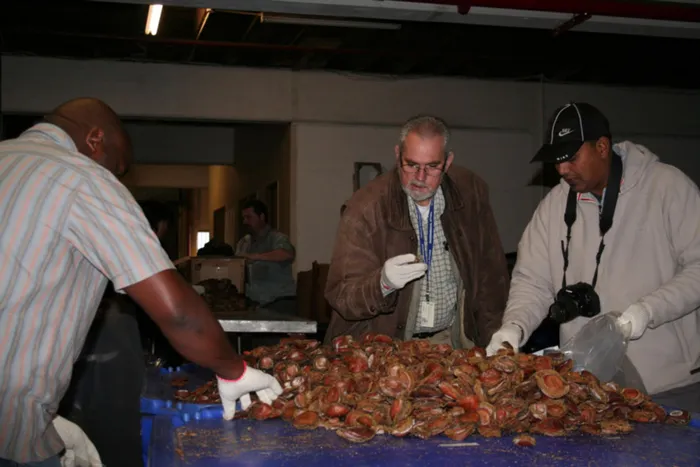
HIDDEN under new duvets in a container bound for Singapore lay sealed boxes of more than 42 000 abalone – shelled, dried and heading for the Asian food markets.
Yesterday, the Hawks, with other police units, confiscated the abalone with a street value of R6 million.
Police described the bust as a blow for the illegal abalone trade. It is also a blow for the declining abalone species, hammered hard by organised crime since 1996.
Lieutenant Colonel Andrè Traut said yesterday the container of duvets and abalone had left Cape Town harbour on a ship more than a month ago.
Only once the ship had sailed did the law enforcement officials come to hear of the abalone on board.
“We couldn’t stop the ship, but we put a block on it, the container, through the Singapore authorities,” Traut said.
The container was sent back to South Africa and when the Hawks and police opened it they found 42 619 abalone in sealed boxes – and the duvets.
“Although no arrests have been affected, we are still pleased with the seizure, and our investigations into the circumstances surrounding the matter could still yield more results. We will continue to fight the illegal abalone trade with the full might of the law, and will not allow criminals to strip our marine resources to enrich themselves,” Traut said.
The Cape Times asked if the Hawks had traced the people or company in Singapore, but Traut would not comment.
Markus Burgener, co-ordinator of Traffic in South Africa, an international NGO that monitors trade in endangered plants and animals, said yesterday’s bust, the third one of its kind, indicated that law enforcement had good informer networks in place.
“These would normally evade routine compliance initiatives. But it also highlights – yet again – that abalone poaching and the illegal trade is run by highly organised and well-resourced criminal networks. The South African government accordingly needs to devote significant financial and human resources to tackling it, and needs to employ the skills of compliance officials in the Department of Agriculture, Forestry and Fisheries, the police, SA Revenue Service, and other national, provincial and local organs of state,” Burgener said.
Intercepting the poached abalone is only one arm of the battle against poaching. The other is to keep the shellfish alive and in the sea. The motto of the now defunct Marines, which ran anti-poaching operations in the Overstrand, was “keep them in the sea”. Much of their work was in patrols, particularly at night, by officers who kept divers from getting into the sea.
A criticism of the current law enforcement activities is that most marine inspectors knock off duty at the end of the day, leaving the night wide open for poaching.
melanie.gosling@inl.co.za