

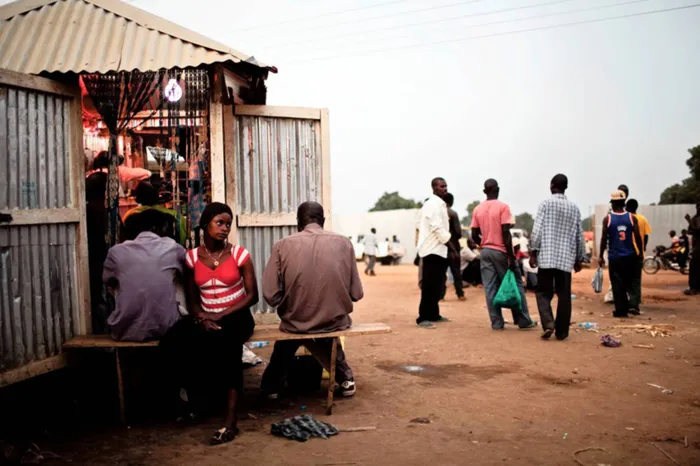
A woman waits outside of a barber shop in the main Konyo Konyo market in the southern Sudanese capital of Juba on Wednesday, July 6, 2011. Konyo Konyo is the main trading center in the Juba, and the city is buzzing with activity as the southern Sudanese government prepares to declare independence from north Sudan on upcoming July 9, following decades of civil war between the north and south of the county. (AP Photo/Pete Muller) A woman waits outside of a barber shop in the main Konyo Konyo market in the southern Sudanese capital of Juba on Wednesday, July 6, 2011. Konyo Konyo is the main trading center in the Juba, and the city is buzzing with activity as the southern Sudanese government prepares to declare independence from north Sudan on upcoming July 9, following decades of civil war between the north and south of the county. (AP Photo/Pete Muller)
Jeremy Clarke Juba, South Sudan
HIGH over a roundabout in south Sudan’s capital Juba, a digital clock counts down the minutes to the independence of the region and flashes the message “Welcome to east Africa’s country number 6”.
Southern Sudan, which is due to secede on Saturday, will remain economically tied to mostly Muslim north Sudan through the pipelines that funnel southern oil up to the Red Sea coast.
But as full statehood approaches, it is doing all it can to build on links with the countries to its east and south, most of them sharing parts of its largely Christian and traditionalist African culture – if only to give it some distance from its former civil war foe.
Kenyans, Ugandans and Ethiopians already dominate the stalls in Juba’s bustling markets, repairing everything from motorbikes to shoes and selling vegetables, hot food and all manner of household goods.
Southern officials say trade with its east African neighbours increased earlier this year when northern forces temporarily blocked fuel and other deliveries through the north/south border. The north denied the reports.
“We have alternatives. When they closed the border we had the road to Ethiopia… We have the road to Uganda, the road to Kenya. So it is not punishing us in terms of business… After a week or two we adjusted,” said Elizabeth Majok, the south’s undersecretary for commerce and industry.
The domination of Juba’s market stalls by east Africans has sparked some local resentment. But foreign traders say they are mostly welcome.
Kenyan Elizabeth Mungai, 28, has a stall on a muddy street in Juba, selling food and a few kitchen and bathroom items, all trucked along the rough roads that cross southern Sudan’s southern border.
“Through the elections, the referendum… for all those things I am here. I proved there is no problem,” she said, referring to southern Sudan’s steps towards independence.
Southerners overwhelmingly voted to leave the north in a January referendum, promised in a 2005 peace deal that ended decades of civil war with the north.
Southern Sudan’s new draft constitution names English – a common business language across east Africa – as the new nation’s language of government and education.
“South Sudan contains enormous agricultural and natural resources ... In a few years, (it) is expected to rebuild its economic infrastructure and improve its trade relations with neighbouring countries,” said Amir Idris, a professor of African and African American Studies at Fordham University in New York.
Up-to-date figures on the size of south Sudan’s trade with east Africa are hard to find.
Kenya’s exports to south Sudan almost doubled between 2005 and 2009, rising to 12.8 billion shillings (R952 million) from 6.8bn shillings after the peace deal.
South Sudan was neighbouring Uganda’s main export market in 2009, when it imported goods worth $184.6m (R1.2bn) from east Africa’s third-largest economy, according to the Uganda Exports Promotions Board.
The south says it wants to join the East African Community trade bloc. Kenya Commercial Bank operates in the south and South Africa’s SABMiller has a brewery.
By contrast, analysts have estimated that the south may be able to add $1bn to its annual budget of around $2bn by getting more revenues from its oil after the split.
That all means the south’s relationship with the north will still remain a priority – even though both sides have still not agreed how they will manage oil revenues and, crucially, how much the north will charge the south to use its pipelines. – Reuters