

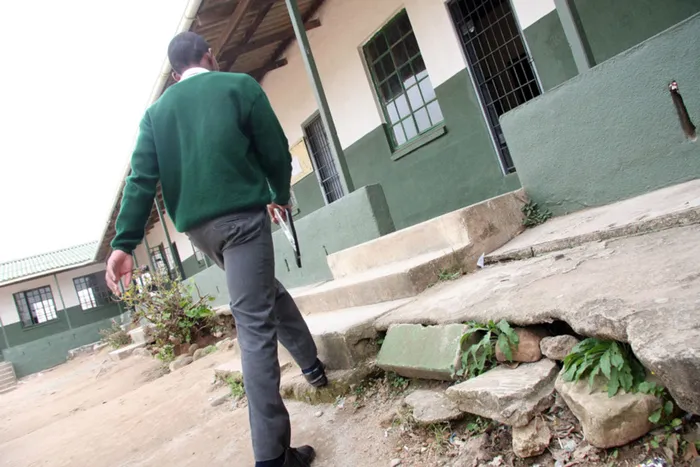
With cracks in classroom walls, leaking roofs and just eight toilets in working order, Mqhawe High School, in the Pinetown district, is in a 'state of dilapidation', according to a report compiled after an inspection of schools by members of the provincial legislature. MPLs found that the situation was replicated at several other urban and rural schools in KwaZulu-Natal. Picture: Jacques Naude With cracks in classroom walls, leaking roofs and just eight toilets in working order, Mqhawe High School, in the Pinetown district, is in a 'state of dilapidation', according to a report compiled after an inspection of schools by members of the provincial legislature. MPLs found that the situation was replicated at several other urban and rural schools in KwaZulu-Natal. Picture: Jacques Naude
Leanne Jansen
leanne.jansen@inl.co.za
EIGHT toilets to serve more than 1 500 people, cavities in the floors the size of potholes, roofs too feeble to deter the rain, and cracks in the walls severe enough for the building to be deemed life-threatening. This is the state of a high school in Durban. And its situation is not unique.
Pit toilets, mud structures for classrooms which are as much as a 10km trek from homes, pupils’ thirst being quenched by dirty spring water, and the absence of electricity are the circumstances in which children at several of the 6 000 schools in KwaZulu-Natal are educated.
This bleak picture was revealed in a report following a tour of numerous urban, township and rural schools by members of the provincial legislature.
The DA has challenged the Public Works Department to explain why the dire situation at some schools has not been remedied after poor and insufficient infrastructure was brought to their attention at the start of the school year.
“We were appalled to find that despite seven months having passed, the province’s Department of Public Works had not effected any real change, while the Education Department had failed to follow-through on the concerns raised earlier,” DA MPL Radley Keys said on Friday.
“At Msawenkosi Primary in Umzinyathi, repairs to a new classroom block comprising six classrooms, which lost its roof during a storm in 2010, still had not been completed. This damage was raised as a matter of priority in our January visit, yet the repairs are not finalised, with the quality of poor workmanship and material visibly of sub-standard quality”.
However, the Public Works Department referred Keys’s indictment to the Education Department for a response. It replied that a contractor was on site at Msawenkosi to make repairs, that included mending the water tanks.
MPLs noted that pupils had to collect water from 3km away after the water tank was damaged by a storm.
Also in the Umzinyathi district, which comprises areas such as Dundee, Greytown and Keates Drift, toilets are listed as outstanding projects for three schools.
IFP MPL Lindani Mncwango, who visited the Amajuba district (Newcastle and surrounds), said she found the state of farm schools there to be “disgusting and shocking”.
According to the report, the 20 pupils of Southfields Primary in Normandien in the Amajuba district are housed in a mud structure and drink dirty spring water.
The mobile classrooms requested in January are only due to be delivered in September.
At Umvoti High School, MPLs demanded that toilets be delivered within a week of their visit. “There are no functional toilets at the school for both educators and learners, while there are 900 learners at the school,” Keys said.
At Nilgiri Secondary in the Pinetown district, sanitation was described as a “health hazard”. Pipes leaked and the toilets had no doors.
The department responded to the problems at both high schools by saying that a contractor would soon be appointed.
Mqhawe Secondary in Inanda North, Pinetown, is described as being in a “state of dilapidation”.
“Classroom walls have cracks. Floors have potholes, roofs are leaking… Eight toilets are working, much more required, at least 51 more toilets,” the report states. And while MPLs noted that one of the school buildings was “life threatening”, according to the department district planners had been sent to evaluate the situation at the school, as no reports of broken toilets had been relayed.
The urgent need for proper sanitation systems also exist in the Uthukela district (areas including Wembezi and Klip-river), where Empolombeni Primary pupils were using pit toilets. The department contends that toilets at the school have been completed.
In the same area, a single tap supplied all of Ezakheni High, while in the Umgungundlovu district, pupils of Ekupholeni High fetched water from nearby households.
“The issue of the water supply is under discussion with the district municipalities. They are water services providers and should be delivering water to schools that should then pay for such deliveries,” the department said.
Kwabhavu High School in the Ugu district (South Coast) has been without power since 2006. In the iLembe district (North Coast area), two schools faced the same problem. In this instance, the response was that the department connected schools to the grid if and where possible, and if no grid existed, solar panels were provided.
According to ANC MPL Linda Hlongwa, chairwoman of the education portfolio committee, at least R42 billion is needed for better infrastructure. She emphasised that while there was a problem with planning on the side of the implementing agents for infrastructure development, too little money was the true culprit.
Public Works declined to field further queries on the matter. According to spokeswoman Sureshinee Govender, the department acts as a service provider, only carrying out maintenance and infrastructure work on government buildings when instructed to do so by the relevant government department.
Pertaining to the state of farm schools, the Education Department said: “The matter of the section 14 schools (public schools built on privately owned land) is a legal matter. Where there is an agreement with the farmer, the department can provide infrastructure to the school. Where there is no agreement, the state cannot use state funds on land that is not governed by an agreement to protect its investment.”